How it works
The five roles in an ordinary moment
Starts it.
Says the thing first. This is usually one person, and they usually say it only once.
Joins in.
Adds to it, or repeats it somewhere else later.
Laughs.
Gives it an audience, and is the biggest group after those who look away.
Looks away.
Says nothing, does nothing, and waits for it to pass.
Steps in.
Changes what happens next, usually in a few words.
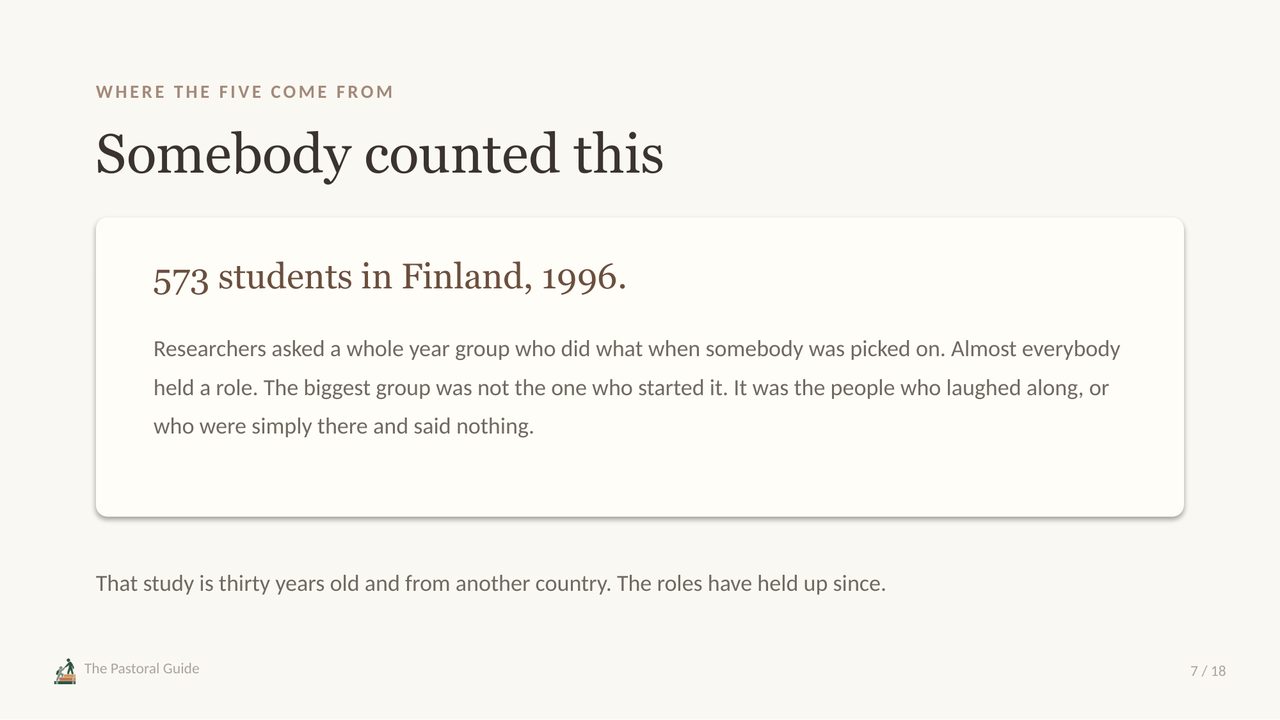
The five roles come from a study of 573 students, and have been in use since 1996.
The lesson starts with six lines on the board describing an ordinary moment. Somebody answers a question wrong, somebody repeats it at break, three people laugh, and by Friday the student it was about has stopped answering questions in that lesson. In pairs, students list everybody who was part of it. Most forms only count two people, but the answer is eight.
Next, pairs look at a study and predict its results before they see them. The study recorded 306 incidents in a playground, and pairs guess how often another child stepped in, and how often the incident stopped within ten seconds when they did. The answers are 19 per cent and 57 per cent, and both are worth discussing with the form.
Students then learn three ways to step in, and one of them can be done without saying anything. You model one example, the class does one together out loud, and then pairs spend twelve minutes writing what they would say about the moment on one of the cards. The sheets then move two tables along, where another pair marks them against three questions. The first is: could anyone actually say this out loud in our school?
This lesson may be close to something that is happening in your form. Do not use a real incident or a real name, and do not run the lesson the day after an incident, because the student it happened to will know it is about them. Nothing students write is collected or read out, and the deck says so before anybody writes anything.
A look inside
Get the lesson
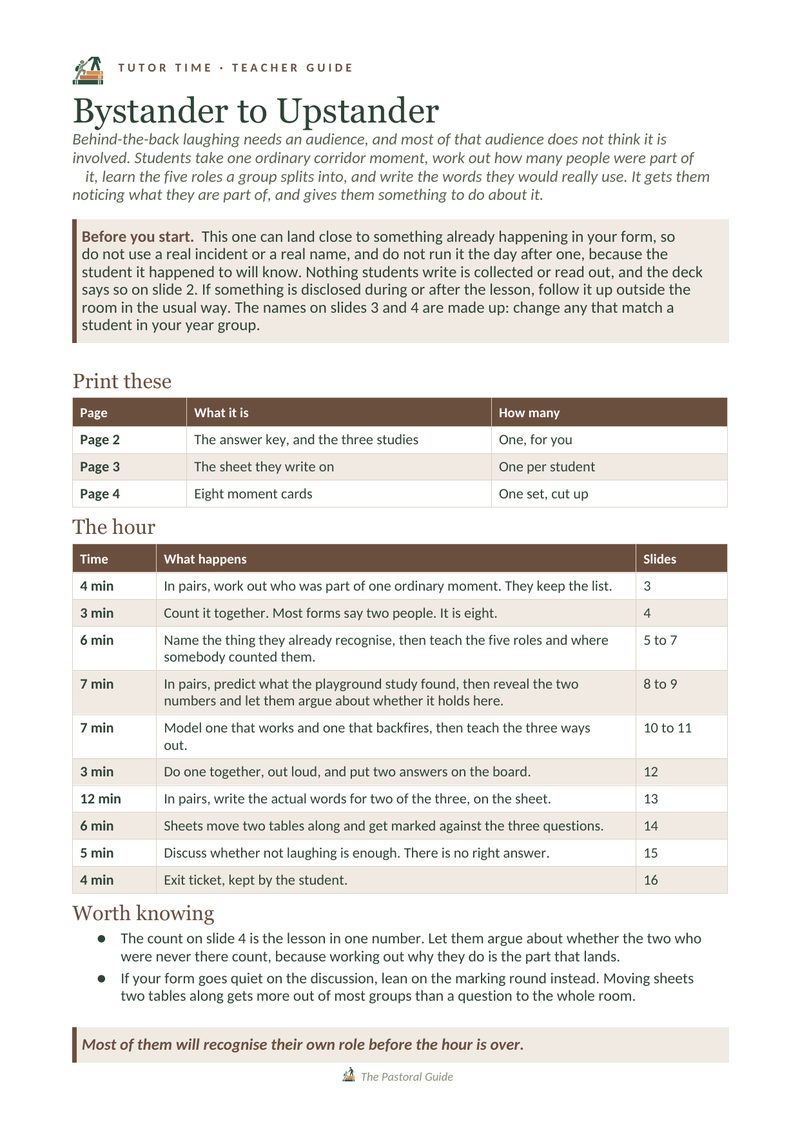
There are three pages to print: the answer key for you, the sheet students write on, and one set of eight moment cards. The names in the script are made up, so change any that match somebody in your year group.
The lesson slides
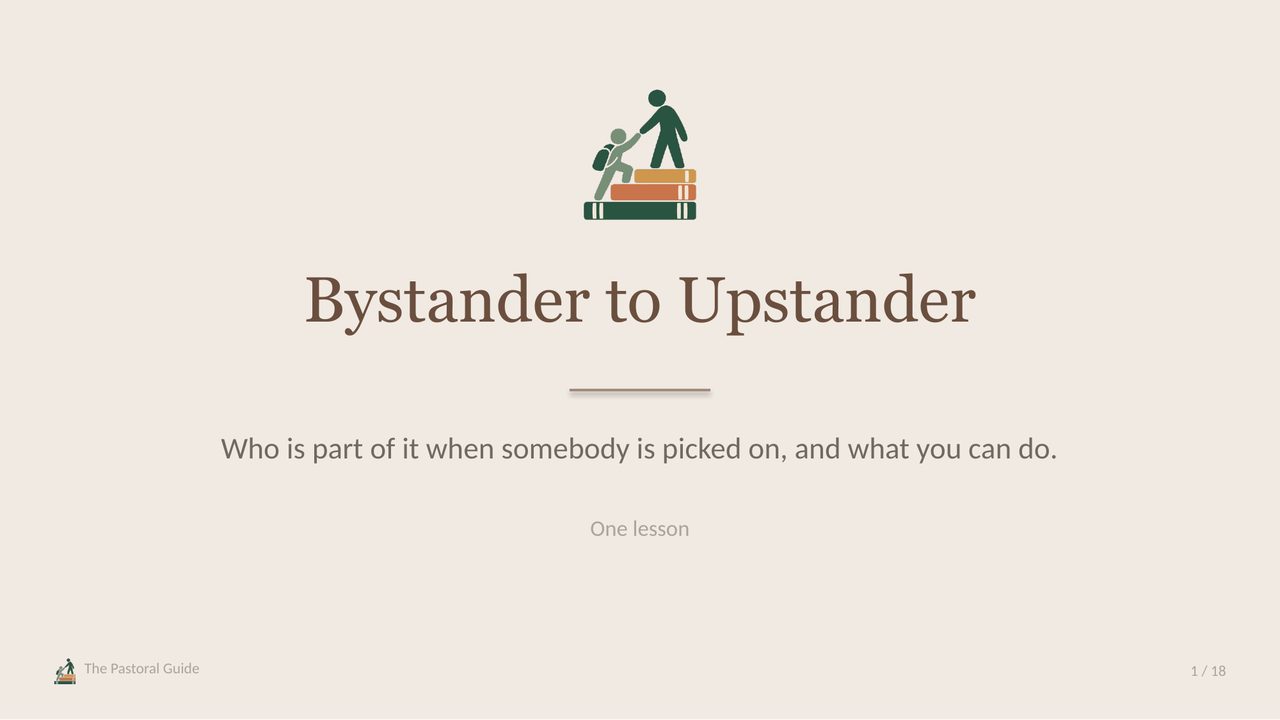
Eighteen slides: the moment to count, the five roles, the study to predict, the three ways to step in, the marking round and the exit ticket.
Download Printable PDFTeacher resource pack
Four pages: the hour with timings against the slides, the answer key and the three studies, the sheet they write on, and eight moment cards.
DownloadNew resources are added as they are made. Leave your email and you will get one email each time something new goes up, and nothing else.
Thank you. A confirmation email is on its way to you, and once you click the link in it, you will be on the list.
Sorry, that did not go through. Please try again, or email thepastoralguide@gmail.com and I will add you by hand.
There are no newsletters, and your address is never shared. How your details are handled.
This is free to download, the same as everything else here. If it saved you some prep time, you’re welcome to leave something toward the site’s running costs.
Support the site