How it works
The four tests a plan has to pass to last four weeks
Small enough.
It takes under ten minutes, because anything longer will not happen on a bad day.
Attached to something.
It follows something they already do, so there is nothing to remember.
Nothing to buy.
It needs no kit, no hall and no extra staff.
Works on a bad day.
They would still do it on a day when they feel like doing nothing at all.
The class writes these four down in lesson three and marks each other’s plans against them.
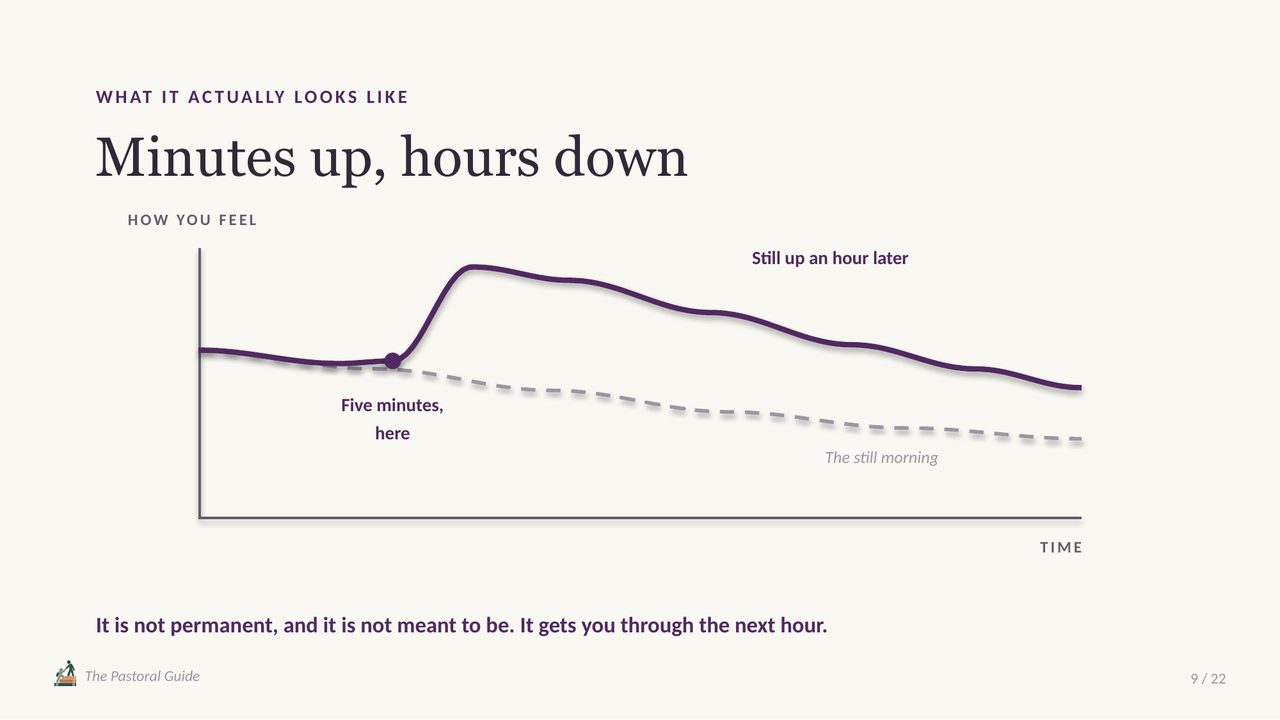
In lesson one, students rank six things by how awake each one would leave them. They then look at what happens in the body, a graph, and three published studies, including a trial on 168 students aged 12 to 15. They predict each result before seeing it, learn how to take a pulse, and write down a prediction in numbers.
In lesson two, students measure their pulse and focus, do five minutes of movement beside their own chair, and then measure both again. They choose from three options (short bursts, strength, or stretch and breathe), and every step has a seated version on the printed card. The class result goes on the board in bands, with no names, and is added to the graph from lesson one.
Lesson three starts with the evidence for why a plan does more than one good session. Each student then writes a plan card that starts at two minutes and grows to five. The cards pass two tables along and are marked against the four tests, and every plan ends with an if-then sentence for the day it goes wrong.
This series stays on movement, mood and focus. It is not about how sporty anybody is, nobody is ranked, and no number leaves the student’s own sheet. The slides say all of that to the class before anybody measures anything. Movement is never offered as a treatment for mental illness, and the pack has a page of safety checks to go through before the lesson, so nobody is asked about their health in front of the room.
A look inside
Get the lesson
Lesson 1 slides
What happens in the body, the graph, three published studies with a predict-the-result activity, how to take a pulse, and the written prediction. About fifty minutes.
Download PowerPointLesson 2 slides
Safety, three measurements around five minutes of movement, the class tally, the comparison with the study, and their numbers on the graph. About forty-five minutes.
Download PowerPointLesson 3 slides
The evidence for four weeks, the four tests, marking each other’s plans, the if-then sentence, and a slide on what to do if you stop. About fifty minutes.
Download Printable PDFTeacher resource pack
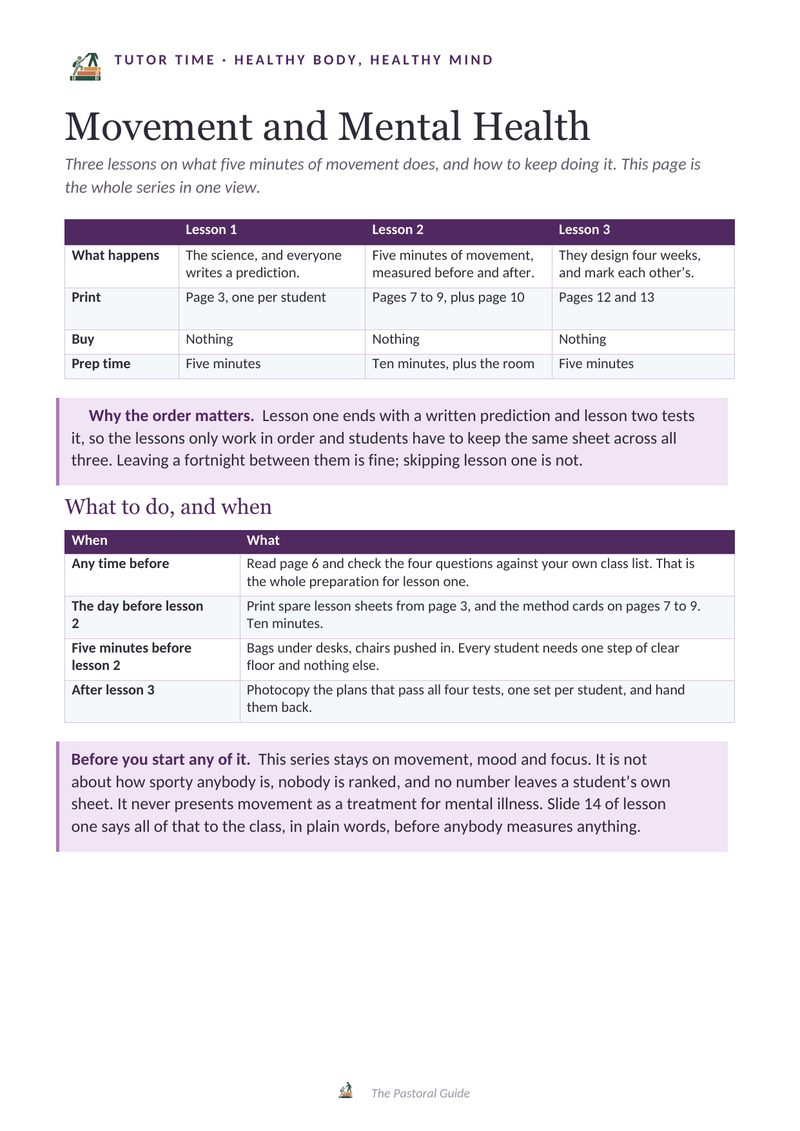
Fourteen pages in lesson order: the whole series on page one, then each lesson’s guide followed by everything that lesson needs to print. Full references on the last page.
DownloadNew resources are added as they are made. Leave your email and you will get one email each time something new goes up, and nothing else.
Thank you. A confirmation email is on its way to you, and once you click the link in it, you will be on the list.
Sorry, that did not go through. Please try again, or email thepastoralguide@gmail.com and I will add you by hand.
There are no newsletters, and your address is never shared. How your details are handled.
This is free to download, the same as everything else here. If it saved you some prep time, you’re welcome to leave something toward the site’s running costs.
Support the site