How it works
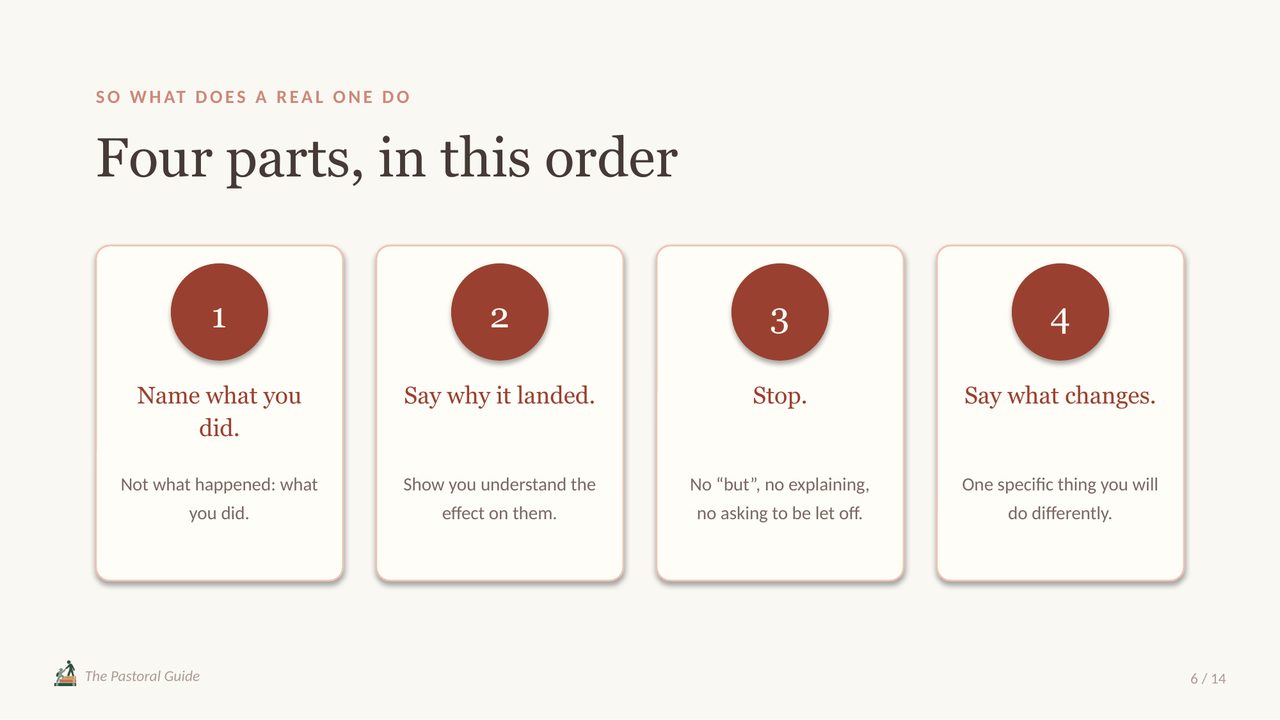
The four parts of a real one
Name what you did.
Say what you did, in plain words, rather than “what happened”.
Say why it landed.
Show you understand the effect it had, as well as the rule.
Stop.
Leave out any “but”, explaining or asking to be let off.
Say what changes.
One specific thing you will do differently.
The four parts go in that order, and part three is the one students find hardest.
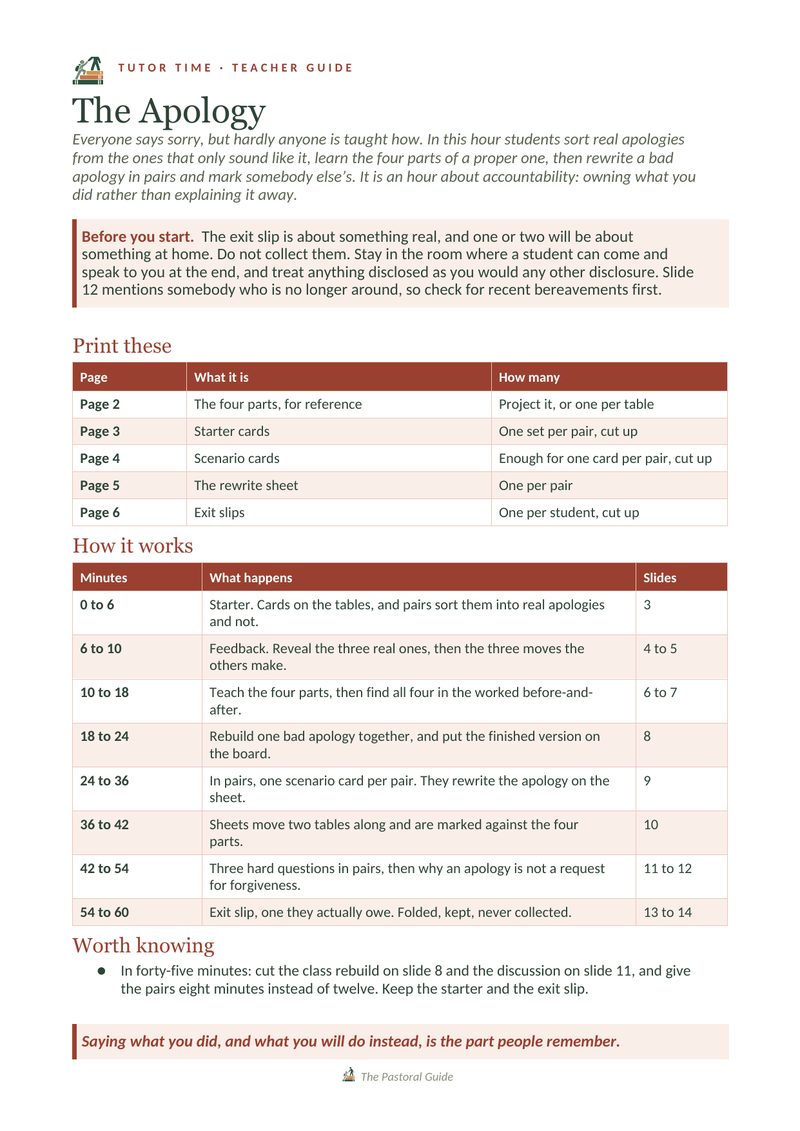
To start, each table gets eight apologies, and pairs sort them into real apologies and ones that only sound like an apology. Pairs will disagree, so talk through the ones they argue about first. The class then takes the three worst apologies apart together.
Next, the slides show a worked before-and-after example. The whole class then rebuilds a bad apology out loud, one part at a time, and you write the finished version on the board.
Each pair then rewrites the apology on a scenario card. The sheets pass two tables along and are marked against the four parts. Finally, each student writes an apology they owe somebody themselves on a private exit slip, which is never collected. For a one-to-one after something has gone wrong, The Repair Sheet is a sheet you fill in together with the student.
Because the exit slips are about something real in students’ lives, one or two will be about something at home. Do not collect them, stay somewhere in the room where a student can come and speak to you at the end, and treat anything disclosed as you would any other disclosure.
A look inside
Get the lesson
The lesson slides
Fourteen slides. Each one is labelled with the part of the lesson it belongs to, so you can teach straight from the deck.
Download Printable PDFTeacher resource pack
Six pages: a print list, the hour with timings, starter cards, scenario cards, the rewrite sheet and the exit slips.
DownloadNew resources are added as they are made. Leave your email and you will get one email each time something new goes up, and nothing else.
Thank you. A confirmation email is on its way to you, and once you click the link in it, you will be on the list.
Sorry, that did not go through. Please try again, or email thepastoralguide@gmail.com and I will add you by hand.
There are no newsletters, and your address is never shared. How your details are handled.
This is free to download, the same as everything else here. If it saved you some prep time, you’re welcome to leave something toward the site’s running costs.
Support the site