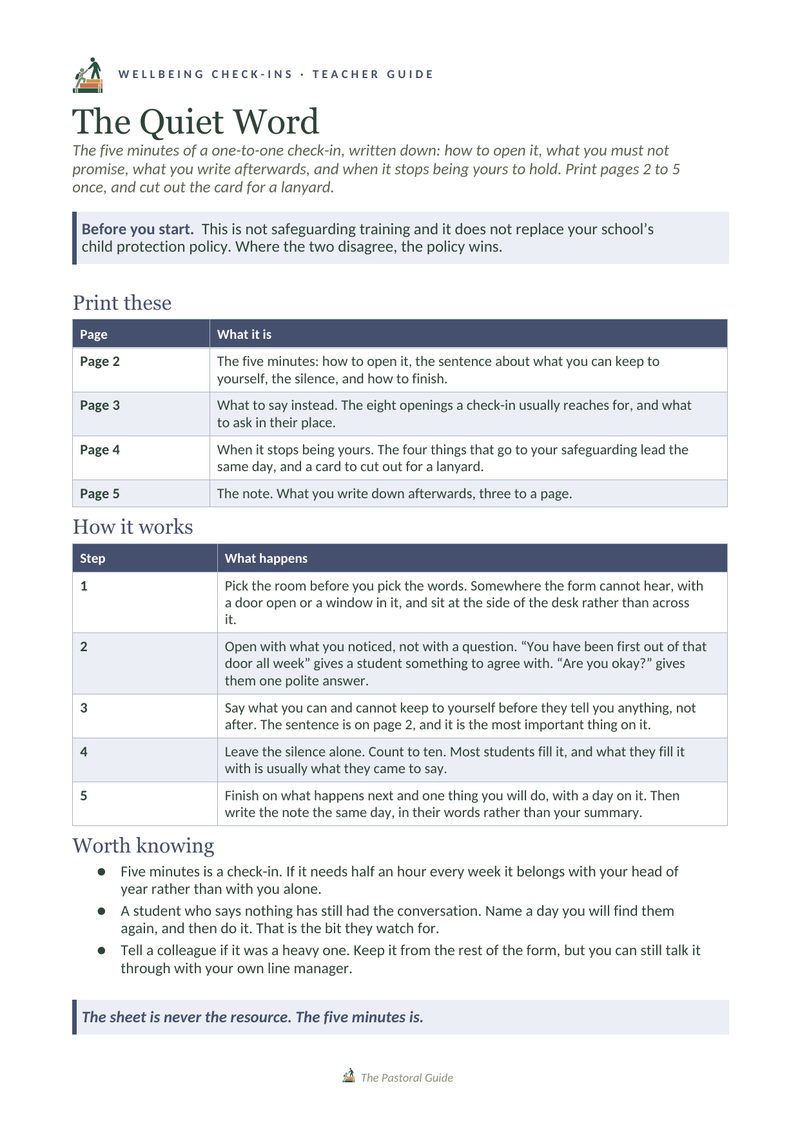
How it works
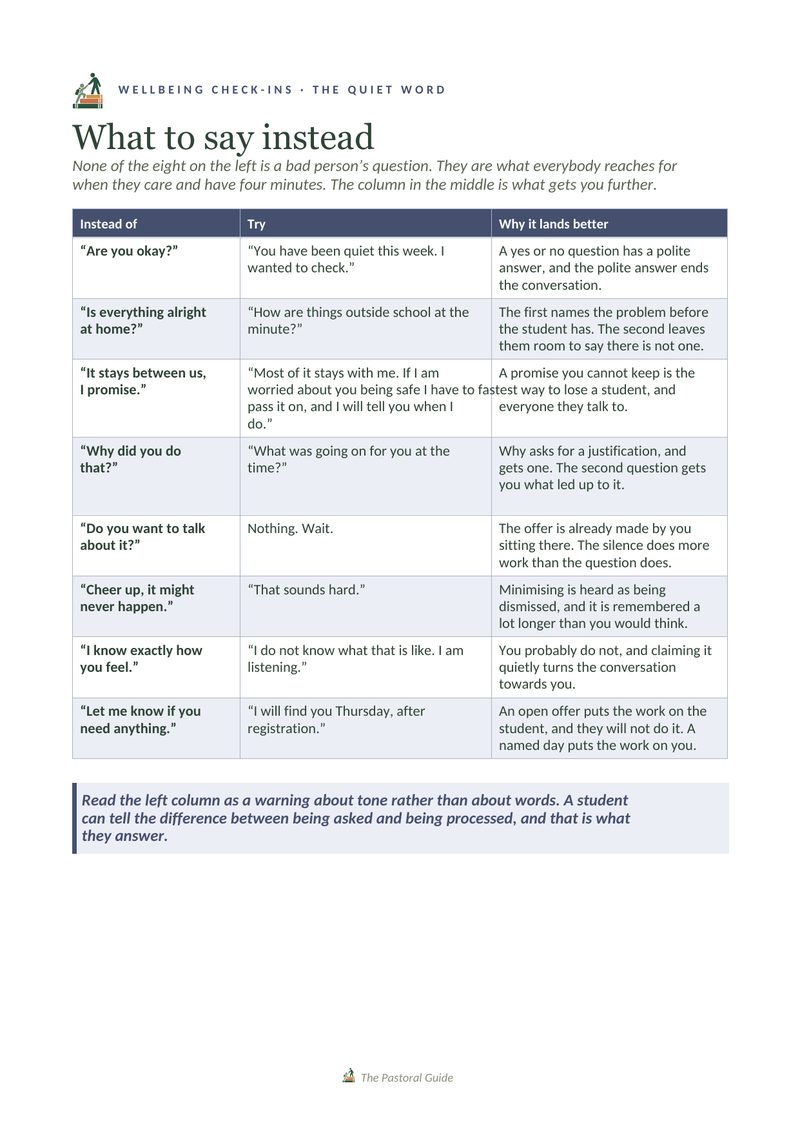
Four of the eight swaps on page three
“Are you okay?”
Try “You have been quiet this week. I wanted to check.” A yes or no question has only one polite answer, and that answer usually ends the conversation.
“It stays between us, I promise.”
Try “Most of it stays with me. If I am worried about your safety I have to pass it on.” Never promise more than that.
“Why did you do that?”
Try “What was going on for you at the time?” A question that starts with “why” asks the student to justify themselves, so a justification is usually what you get.
“Let me know if you need anything.”
Try “I will find you Thursday, after registration.” A named day means they do not have to come and find you.
The other four cover asking about home, filling the silence, telling a student to cheer up, and saying that you know exactly how they feel.
Choose somewhere the rest of the form cannot hear you, but where the two of you can still be seen, with the door open or a window in it. Sit at the side of the desk rather than across it, and tell the student how long you have got. It is easier for a student to start talking if they know when it will end.
Page two of the pack gives you a sentence to use. Never promise that what they tell you will stop with you, however much you want to. If you have to break that promise, the student may never confide in you again, or in any other adult in the school.
Before you finish, go over what you have understood, what happens next and who else will be involved, then agree one thing you will do and put a date on it. The pack has three note slips to a page. The Check-In Record Sheet is a spreadsheet for keeping track of which students you have spoken to across the year, without recording what was said.
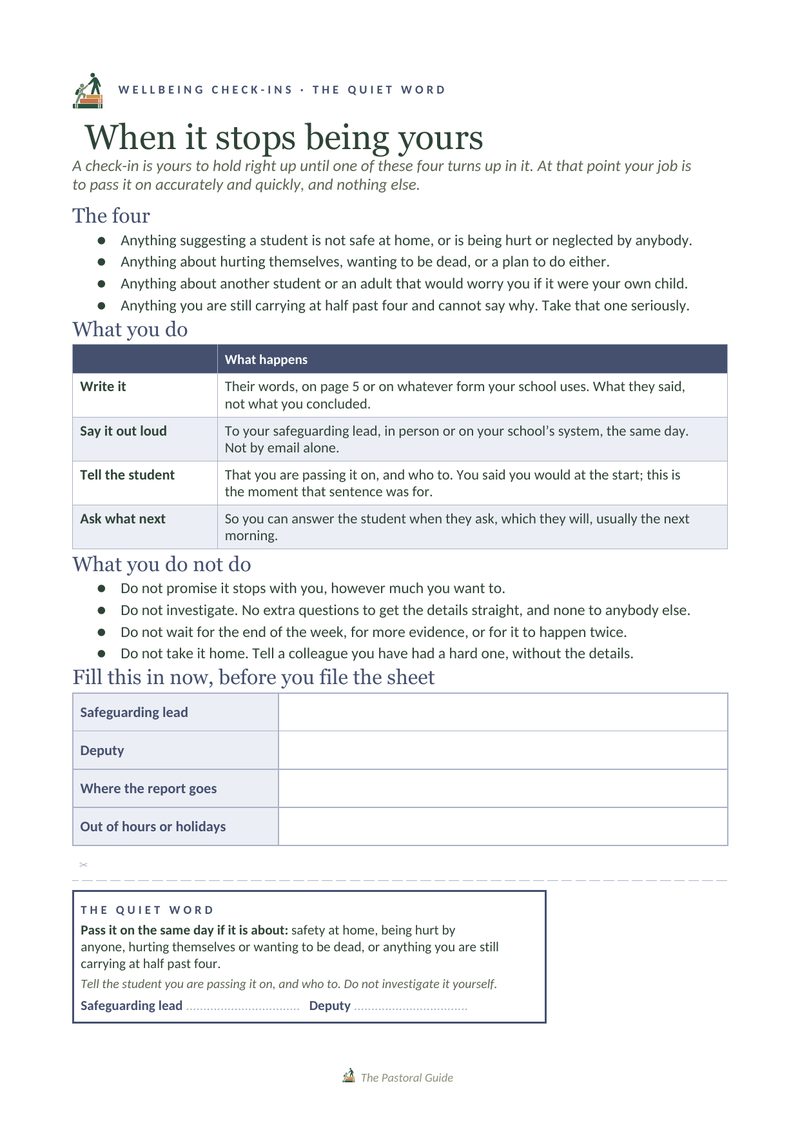
Page four is the one to read before you ever need it: the four things that go to your designated safeguarding lead the same day, what you do about each, and the four things you do not do, including investigating it yourself. There is a box for your safeguarding lead’s name, and a card to cut out for a lanyard. This is not safeguarding training and it does not replace your school’s child protection policy. If the two ever disagree, follow your school’s policy.
A look inside
Get the resource
Print the five pages once, keep them where you plan, and cut the card out for your lanyard.
Teacher resource pack
Five pages: the teacher guide, the shape of the five minutes, eight things to say instead, when it stops being yours with a card to cut out, and the note, three slips to a page.
DownloadNew resources are added as they are made. Leave your email and you will get one email each time something new goes up, and nothing else.
Thank you. A confirmation email is on its way to you, and once you click the link in it, you will be on the list.
Sorry, that did not go through. Please try again, or email thepastoralguide@gmail.com and I will add you by hand.
There are no newsletters, and your address is never shared. How your details are handled.
This is free to download, the same as everything else here. If it saved you some prep time, you’re welcome to leave something toward the site’s running costs.
Support the site